
Biscoff Mug Cake: 5-Minute Single-Serving Cake With a Molten Cookie Butter Top

This Biscoff mug cake is the single-serving one: speculoos cookie butter stirred straight into the batter, a second spoonful melting over the top, and the whole thing on a spoon in about five minutes. It's a different job from the no-bake Lotus Biscoff cheesecake or the easy Biscoff tiramisu elsewhere on this site, since both of those are chilled projects you start hours ahead. This one is for a craving you want handled tonight. One mug, one fork, no oven, nothing to set.
Why you'll love this
- Five minutes from jar to spoon, mixed and cooked in the same mug, so there's exactly one thing to wash.
- The cookie butter does two jobs: caramel-spice flavor through the crumb, and a molten spoonful over the top.
- No oven, no mixer and no chilling, unlike the Lotus Biscoff cheesecake or the Biscoff tiramisu, which both need hours in the fridge.
- Real timings to calibrate against, from a 700-watt microwave up to an 1100-watt one.
- All the speculoos spice comes ready-made in the jar, so no spice rack is involved.
- Steer it how you like: pull it early for a molten center, or give it 15 seconds more for a fluffier crumb.
Key ingredients & how to use them
- Biscoff cookie butter — the flavor and most of the fat. Warm it 10 to 15 seconds for the batter so it stirs in without streaks, but keep the topping spoonful cold and firm. Warm spread thins out and slides straight to the bottom of the mug.
- All-purpose flour — the structure. Spoon it into the tablespoon and level it off; four level tablespoons is about 30 grams. Scooping straight from the bag packs in closer to 40, and that extra flour is the single most common reason a mug cake comes out dry.
- Sugar — only a tablespoon, on purpose, because the spread is already very sweet. Sugar also holds onto water, which keeps the crumb soft. Add more and the top turns sticky and the middle sinks.
- Baking powder — the lift, and it does its whole job in about 60 seconds. Level the quarter teaspoon. Too much makes the cake balloon, collapse, and taste faintly metallic.
- Milk — the moisture, dairy or plant-based. Room temperature is better than fridge-cold, which can make loosened cookie butter seize into grains. The finished batter should mound on the spoon and fall in a slow ribbon.
- Vegetable oil or melted butter — tenderness. Oil stays liquid as the cake cools, so it stays soft for longer; butter tastes richer but firms the crumb within a few minutes of coming out.
- Salt — one pinch, and don't skip it. Without it, three tablespoons of cookie butter read as flat and cloying rather than caramel and spice.
- Vanilla extract — optional, a quarter teaspoon, and it rounds off the burnt-sugar edge of the speculoos. Nothing breaks if you leave it out.
How to make it (step by step)
-
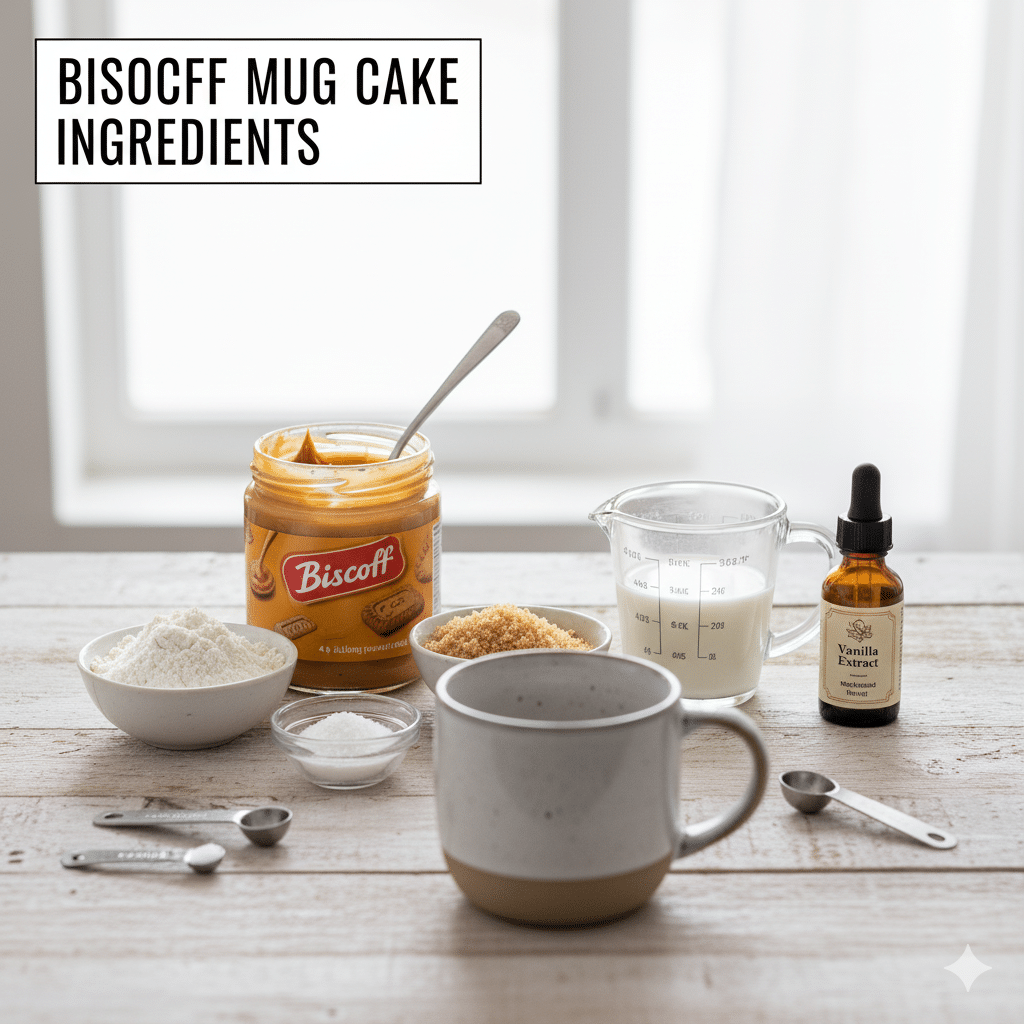 1
1Pick the mug, loosen the Biscoff
Use a straight-sided mug that holds at least 12 ounces, because this batter roughly doubles at its peak before settling. Spoon the cookie butter in, set about two teaspoons of it aside on a saucer for later, and microwave the mug for 10 to 15 seconds. Cookie butter doesn't melt like chocolate, it just loosens, going from spreadable to glossy and pourable. Stop there; left alone for much longer it scorches against the hot ceramic.
-
2
Stir in the wet ingredients
Add the milk, the oil or melted butter and the vanilla, then stir until the mug holds one smooth caramel-colored liquid. Drag your spoon around the bottom corners, because that's where a cold slick of spread hides. If the mixture goes grainy or beady, your milk was fridge-cold. Eight seconds back in the microwave and another stir brings it together.
-
3
Add the dry ingredients, then stop
Tip in the flour, sugar, baking powder and salt and stir about 20 strokes, just until the last dry streak vanishes. Lumps the size of a grain of rice are fine and cook out. A perfectly smooth, beaten-to-death batter will not, because every extra stir builds gluten, and gluten plus the fast steam of a microwave is exactly what makes a mug cake bouncy.
-
4
Level it, and add a molten pocket if you want one
Level the surface with the back of your spoon and check that the batter sits no higher than halfway up the mug. For a molten center, drop one of the reserved teaspoons of Biscoff on top and press it down about half an inch. Use it cold and stiff from the jar here, not warmed, and don't push it any deeper than that.
-
5
Microwave in 30-second increments
The first time you make this, cook 30 seconds, look, then go another 30. That's your calibration run and it costs you nothing but a peek. A 1000-watt oven usually lands right around 60 seconds, an 1100-watt one is often done at 45 to 50, and a 700-watt one can want 85 to 90. After that, cook straight through to your number and top up in 10 to 15 second bursts.
-
6
Read the doneness cue
You're looking for a set edge that's just starting to pull away from the mug, and a domed center that's springy but still barely tacky to a fingertip. Press it lightly: a small dent that fills back in slowly means stop now. If the whole surface looks dry, matte and firm, you've gone past it, so pull the next one 15 seconds earlier.
-
7
Rest two minutes for carryover
Set the mug on the counter and leave it alone for a minute or two. The ceramic is holding serious heat and the cake keeps cooking inside it, firming up noticeably over the first 60 to 90 seconds. That carryover is the whole reason you stop while the center still looks a little underdone. It's also blisteringly hot straight out, so this rest saves your tongue.
-
8
Spoon the molten Biscoff on top
Drop the last reserved teaspoon of cookie butter onto the hot cake and give it 20 seconds; it slumps into a glaze on its own, no melting required. Crumble a Lotus cookie over the top for the crunch the soft crumb is missing. Eat it out of the mug within about ten minutes, while the center is still soft.
Troubleshooting
- Rubbery and bouncy — overmixed, overcooked, or both. Stir only until the dry streaks disappear, and remember that 15 extra seconds in a microwave does more damage than five extra minutes in an oven. Next time pull it while the center still looks tacky.
- Dry and crumbly — almost always scooped flour rather than spooned and leveled, which can add a third more flour than the recipe wants. Cutting the cook time by 10 seconds and adding a teaspoon more milk fixes the rest.
- Raw, sunken middle — usually a tall narrow mug, where the center sits too far from the heat and collapses once the edges set. Switch to a wider, squatter mug, level the baking powder carefully, and add time in 15-second bursts.
- It overflowed — the mug was too small or filled past halfway. Batter climbs to roughly double before it settles, so use 12 ounces or more, fill it halfway, and stand the mug on a small plate.
- The Biscoff sank to the bottom — the pocket spoonful was warmed, or pushed in too deep, or the batter was too loose to hold it. Use it cold and firm, press it only half an inch down, and keep the batter thick enough to ribbon slowly off a spoon.
Pro tips
- Stand the mug on a small plate. If it does climb, you wash a plate instead of the microwave floor.
- Cook to the cue, not the clock, then write your microwave's number inside a cupboard door so you never guess again.
- Wide beats tall. A squat straight-sided mug cooks evenly; a tall narrow one leaves a raw core under a set top.
- Use a fork, not a whisk. It reaches the corners of the mug and makes overmixing much harder to do by accident.
- Making two? Cook them one at a time. Two mugs split the same power, so neither one hits your timing.
Variations & substitutions
- Chocolate Biscoff: stir a tablespoon of chocolate chips into the finished batter for melting pockets through the crumb.
- Coffee speculoos: dissolve a quarter teaspoon of instant espresso in the milk. It deepens the caramel without tasting of coffee.
- Self-rising flour: swap it in for the all-purpose and leave out the baking powder entirely.
- Dairy-free: use plant milk and oil rather than butter. Biscoff spread itself contains no dairy.
- Any speculoos spread: supermarket cookie butter works the same way, though some are looser, so hold back a teaspoon of milk.
Storage & make-ahead
The useful make-ahead here is the dry mix: shake the flour, sugar, baking powder and salt together in a small jar, make up four or five jars at once, and they'll keep for three months. Then it's just cookie butter, milk and oil on the night. The cooked cake is best inside ten minutes. If it sits and stiffens, add a teaspoon of milk and reheat for 8 to 10 seconds. Don't refrigerate it; cold makes mug cakes go stale within hours.
Serving ideas
A small scoop of vanilla ice cream on the hot cake is the obvious move, and it's obvious because it works: the melt runs into the crumb and meets the Biscoff glaze halfway. Crushed Lotus cookies give you the crunch. A spoonful of lightly whipped cream and a pinch of flaky salt is the grown-up version, and cold espresso alongside cuts the sweetness better than anything else I've tried.
More recipes to try
Five minutes and one mug is a dangerous habit to start. On lighter days I make the 100 calorie mug cake instead, and the paleo mug cake when I'm off grains and refined sugar. When the craving is straight-up chocolate rather than spiced cookie butter, the hot chocolate mug cake does the job just as fast.
Recipe
Biscoff Mug Cake: The 5-Minute Dessert That You Will Fall In Love With
Ingredients
- 3 tbsp Biscoff cookie butter
- 4 tbsp all-purpose flour
- 1 tbsp Sugar
- 1/4 tsp Baking Powder
- Salt pinch
- 4 tbsp of milk (dairy, or non-dairy).
- 1 tbsp vegetable or melted butter
- 1/4 tsp vanilla extract (optional)
Instructions
- Microwave the cookie butter in a mug for 10 seconds, holding back about 2 teaspoons for the top.
- Add the milk, oil and vanilla. Stir until smooth.
- Add the flour, sugar, baking powder and salt. Mix until there are no dry spots.
- Microwave 1 minute. Add 10 to 15 seconds more if needed for texture.
- Let it cool for a minute or two, then spoon the reserved Biscoff over the top and enjoy it warm.
Tips & notes
- Do not overmix, it keeps the cake light.
- Microwave time can be adjusted slightly depending on the wattage.
- Add crushed Biscoff or ice cream to the top for an instant upgrade.
- Undercook it by 5 to 10 seconds for a gooey texture.
- It is best enjoyed fresh, but you can keep it covered for up to one day.
Watch how to make it
Nutrition · per serving (estimate)
Made this recipe?
Tap the stars to leave your rating — it helps other home cooks.
Frequently asked questions
Why did my mug cake turn out dry or rubbery?
Almost always overcooking or too much flour. Microwaves keep cooking from residual heat, so stop the moment the top springs back, and spoon and level the flour rather than scooping straight from the bag. Fifteen seconds too long is enough to take it from soft to bouncy.
How do I keep the center gooey?
Slightly undercook it. Pull the mug 5 to 10 seconds before the top looks fully set, while the center is still barely tacky, and let carryover heat finish the job during the rest. For an extra-molten core, press a cold teaspoon of Biscoff into the middle of the batter before microwaving.
My microwave is more or less powerful than 1000 watts. How do I adjust?
Cook to the cue, not the timer. An 1100-watt oven often needs only 45 to 50 seconds, while a 700-watt one can take 85 to 90. The first time, run it in two 30-second bursts, then finish in 10-second bursts and write down the total that worked.
Why warm the Biscoff before mixing it in?
Cold cookie butter is stiff and leaves lumps you can't fully stir out. Ten to fifteen seconds in the microwave loosens it, not melts it, so it blends evenly into the batter. Keep the topping spoonful cold, though, because warm spread is too runny to sit on top.
Why did my Biscoff sink to the bottom?
You either warmed the spoonful you buried or pushed it in too far. Cookie butter loosens fast and thin cookie butter sinks through cake batter as it heats. Use it stiff from the jar and press it only about half an inch below the surface.
Do I need an egg in a mug cake?
No, and this one is better without. A whole egg is too much for a single serving, and it tends to set faster than the flour does in a microwave, which gives the cake a slightly eggy, omelet-like edge. The cookie butter and oil supply the richness instead.
Can I double it and cook both mugs together?
Double the ingredients into two separate mugs, never one, or the middle stays raw. Cook them one at a time as well: two mugs share the same output, so each takes far longer than the timings here and neither cooks evenly.
Can I make this without a microwave?
Yes. Use an oven-safe ramekin and bake at around 350°F (175°C) for 12 to 15 minutes, until the edges are set and the center is just firm. It comes out more cake-like and less molten than the microwave version.
Why does my mug cake overflow?
The batter rises a lot in the microwave, roughly doubling before it settles, so a small mug spills over. Use one that holds at least 12 ounces (about 1.5 cups) and fill it no more than halfway. Standing the mug on a plate saves the cleanup either way.
Can I prep it ahead?
Mix the flour, sugar, baking powder and salt in a small jar and it keeps for about three months. On the night, tip it into the mug with the loosened cookie butter, milk and oil. The cooked cake doesn't keep well, so it's worth making fresh each time.


Leave a review