
Cheesecake French Toast (Cream Cheese Stuffed Brunch Recipe)
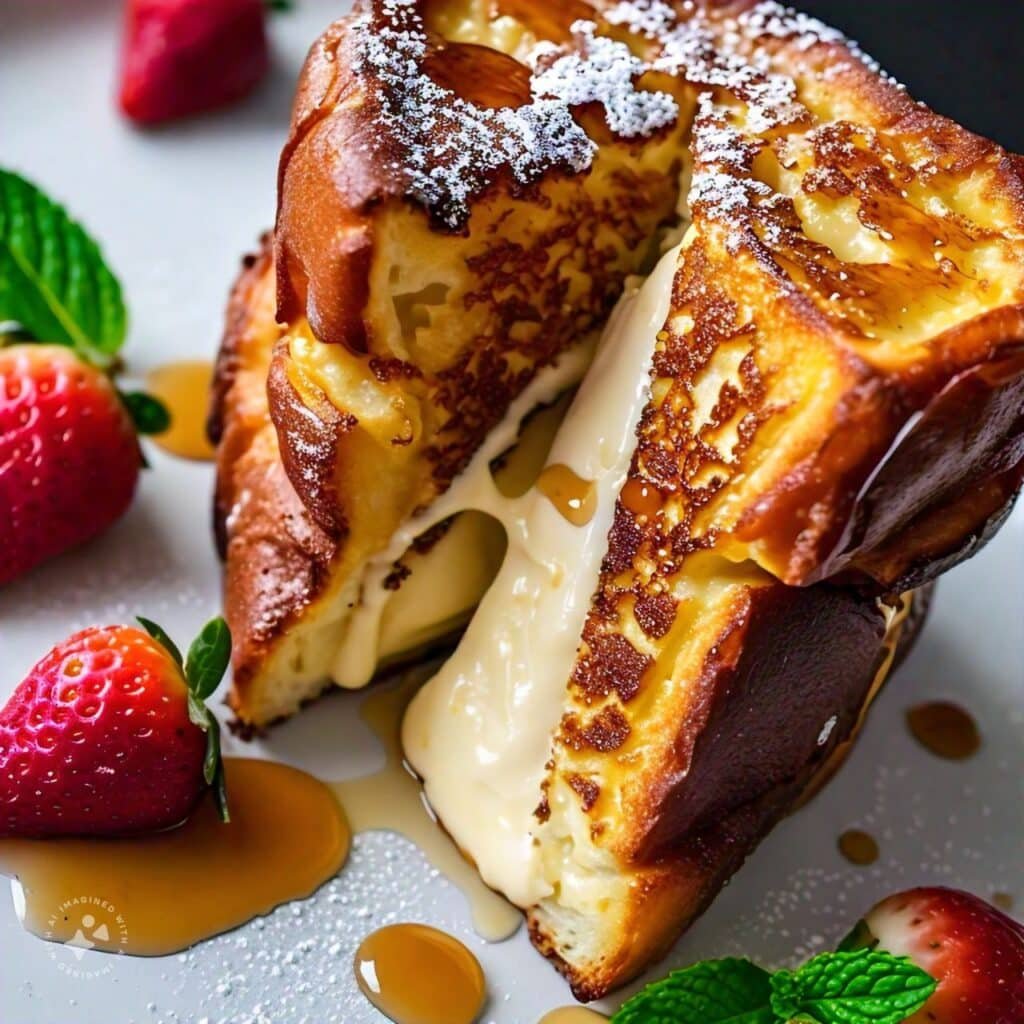
Cheesecake French toast is a stuffed breakfast sandwich: sweetened cream cheese sealed between two thick slices of brioche, dipped in spiced custard and pan-fried until the outside is golden and the middle is warm and creamy. It isn't a chilled or baked dessert like my no-bake cheesecake or vanilla cheesecake, and it isn't a sweet dough like cheesecake croissant buns or strawberry cheesecake buns. No oven, no chilling, no springform pan. Just a skillet, about 25 minutes at the stove, and bread that's dry enough to drink the custard without falling apart.
Why you'll love this
- It's breakfast, not dessert: no springform pan, no overnight chill, no oven, just a skillet and about 25 minutes at the stove.
- A cream cheese filling thick enough to stay sealed inside the bread instead of running out into the butter.
- Real cues for the parts everyone gets wrong: how long to dip, what medium heat actually looks like, and how to tell the center is warm.
- Eight slices of bread make four stuffed sandwiches; halve them on the diagonal and one skillet feeds eight.
- Pantry-standard ingredients, and the sandwiches can be built the night before.
Key ingredients & how to use them
- Thick-cut brioche or challah — enriched with egg and butter, so the crumb is tight enough to carry filling and custard at once. Cut your own slices about three-quarters of an inch thick. Thin sandwich bread collapses into mush the second it's dipped.
- Day-old bread — stale is a feature here. Leave the slices uncovered on a rack overnight, or dry them in a 275°F oven for 8 to 10 minutes. Dry crumb pulls custard in; fresh bread is already full of its own moisture and has nowhere to put it.
- Full-fat block cream cheese — the tang and the body. Soften it 30 to 45 minutes at room temperature so it whips smooth, because cold cream cheese stays lumpy no matter how hard you beat it. Tub-style spreadable cream cheese is too loose and runs out in the pan.
- Powdered sugar — sweetens and thickens. The cornstarch in it gives the filling enough structure to hold when it warms. Granulated sugar stays gritty and draws water out of the cream cheese, which is exactly how you get a runny center.
- Vanilla extract — half a teaspoon is plenty. Every extra spoonful of liquid, vanilla or lemon juice or cream, loosens the filling, so reach for zest or paste when you want more flavor.
- Eggs — two eggs to half a cup of milk is a deliberately rich ratio. It coats and sets fast instead of soaking deep. Whisk until no ropes of white remain, or you'll get pale scrambled patches on the crust.
- Whole milk — thins the eggs just enough to coat evenly. Half-and-half makes a richer custard that browns faster, so drop the heat a notch. Skim milk gives you a watery dip that never sets into a custardy layer.
- Cinnamon and nutmeg — whisk them into the eggs before the milk goes in so they disperse instead of floating as specks. Freshly grated nutmeg is worth the thirty seconds; pre-ground fades fast and mostly tastes dusty.
- Butter for the pan — browning and flavor. Add it a tablespoon at a time and wipe the skillet between batches, because the milk solids left behind will blacken and give the next sandwich a bitter, scorched crust.
How to make it (step by step)
-
1
Dry the bread out first
Cut eight slices about three-quarters of an inch thick, or use pre-sliced brioche if it's genuinely thick. Spread them on a rack for a few hours, or dry them in a 275°F oven for 8 to 10 minutes until the surface feels papery but the slice still bends. This is the step most people skip, and it's the reason their toast turns to mush.
-
 2
2Whip the filling until it holds a ridge
Beat the softened cream cheese with the powdered sugar and vanilla for 60 to 90 seconds. You're after the texture of thick frosting: drag a spatula through and the furrow should hold instead of flowing back. Lumps mean the cream cheese was still cold, and no amount of beating fixes that. Give it 20 more minutes on the counter and try again.
-
 3
3Fill and seal the sandwiches
Mound a scant 2 tablespoons of filling in the middle of four slices, then spread it out to within half an inch of the edge. Press the second slice on top and run the heel of your hand around that clean border, compressing the crumb into a seal. That pressed rim is the gasket. Without it, the filling finds its way out the moment the pan heats up.
-
 4
4Whisk the custard smooth
Beat the eggs with the cinnamon and nutmeg first, then whisk in the milk. Thirty seconds of steady whisking does it: the mixture should be one uniform beige with no clear streaks of white left floating. Use a wide shallow dish, a pie plate or an 8-inch square pan, so a whole sandwich lies flat instead of getting dipped corner by corner.
-
 5
5Heat the pan, then dip
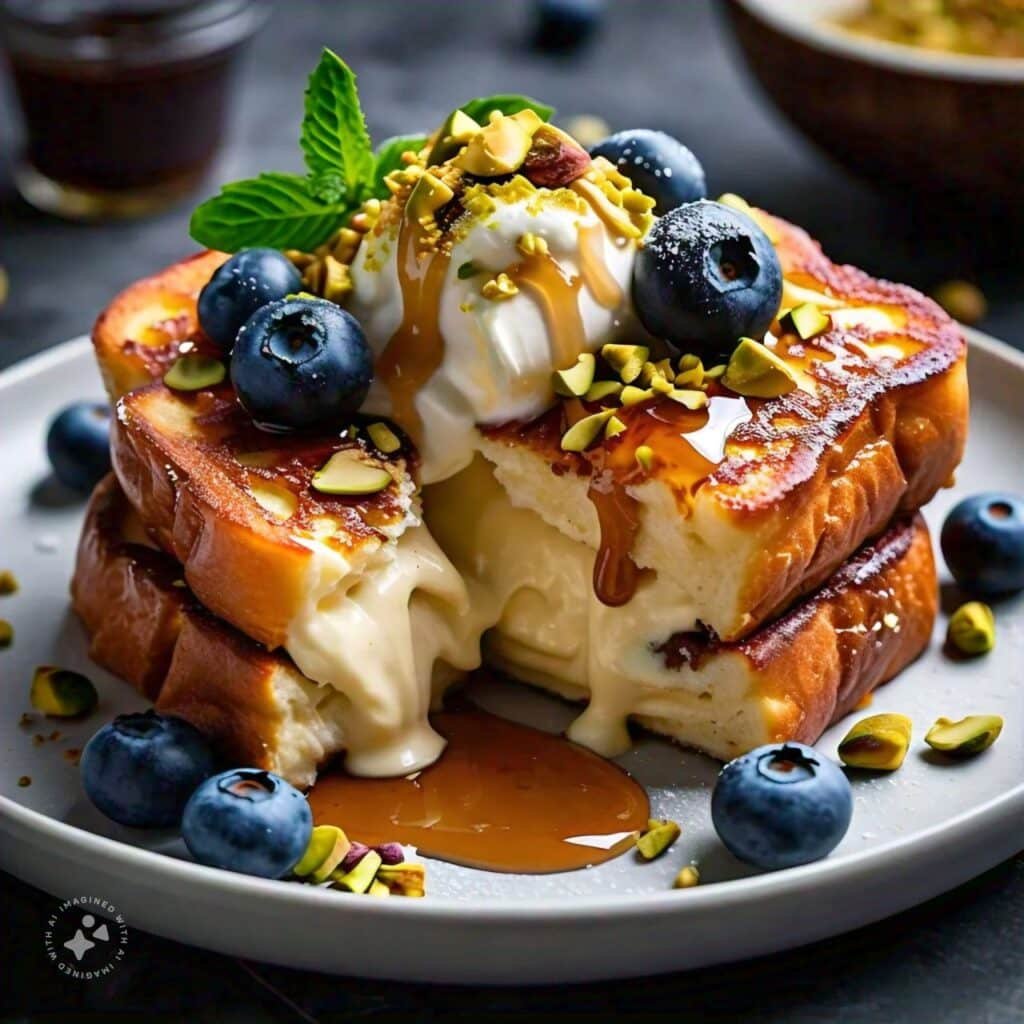
Set a skillet over medium and melt a tablespoon of butter; it should foam and settle without browning, roughly 325°F on an electric griddle. Lay each sandwich flat in the custard for 8 to 10 seconds a side, pressing lightly in the center so the middle gets its share. Lift with a spatula, pause two seconds to let the drips fall, and go straight into the pan.
-
6
Cook the first side without touching it
Lay the sandwich down away from you and leave it alone for a full 3 minutes. Listen for a steady, quiet sizzle; a sharp crackle means the pan is too hot. The edges will shift from wet and glossy to matte and set. Lift a corner at 3 minutes and look for mottled deep golden brown, not an even pale tan.
-
7
Flip and finish the second side
Slide the spatula fully underneath, support the whole sandwich, and turn it in one motion so the filling doesn't shear sideways. Add another small knob of butter beside it and cook 3 to 4 minutes more. If the second side browns in under 3 minutes, the pan crept up on you. Nudge the heat down and give the center time to catch up.
-
8
Check that the center is actually warm
Press the middle with a fingertip: it should feel springy and full, not squishy and cold. With an instant-read thermometer, slide the probe in from the side into the filling; 140 to 150°F means warmed through. A dark crust hiding a cold center just needs 4 or 5 minutes on a rack in a 325°F oven.
-
9
Hold the batch warm, then serve
Move finished sandwiches to a wire rack set on a sheet pan in a 200°F oven while you cook the rest. Stacked on a plate they steam and the bottom goes limp; on a rack they stay crisp for a good 20 minutes. Halve each one on the diagonal, dust with powdered sugar, and pour the syrup at the table.
Troubleshooting
- Filling leaks into the pan — you spread it right to the crust, or it softened while you worked. Keep a clean half-inch border, press the edges to seal, and chill the assembled sandwiches 10 minutes before they meet the custard.
- Soggy, custardy middle — too long in the dip, or bread that was too fresh and too thin. Cut back to 8 to 10 seconds a side and dry your slices first. A batch that's already cooked can be rescued with 5 to 6 minutes in a 325°F oven.
- Dark crust, cold center — the pan was running hot, so the outside finished in two minutes while the cream cheese sat at fridge temperature. Butter that browns the instant it hits the pan is your warning. Wipe the skillet, let it cool a minute, restart at medium.
- Bread tears when you lift it out of the custard — thin or fresh slices give up under the weight of the filling. Slice thicker, dry the bread, and lift with a wide spatula under the whole sandwich rather than pinching one corner.
- Filling too runny to spread — tub cream cheese, over-microwaved cream cheese, or extra liquid from juice or cream. Switch to block cream cheese, beat in another tablespoon of powdered sugar, and chill the bowl 15 minutes until it holds a ridge again.
- Lumpy filling — cold cream cheese, every single time. You can't whisk lumps out. Rest the bowl in a few inches of warm water for 5 minutes, then beat it again.
Pro tips
- Build every sandwich before you turn on the burner. Once the pan is hot this moves quickly, and a sandwich stalled in the custard turns to porridge.
- Two at a time in a 12-inch skillet. Crowding drops the pan temperature and steams the crust instead of browning it.
- Ten minutes in the fridge after assembly makes the sandwiches noticeably easier to dip, lift and flip.
- Wipe the pan with a paper towel between batches and add fresh butter; leftover browned solids taste burnt on round two.
- The custard is intentionally tight at 2 eggs to half a cup of milk. If you run short on the last sandwich, whisk in one more egg and 2 tablespoons of milk rather than scraping the dish.
Variations & substitutions
- Strawberry cheesecake: beat 1 tablespoon of thick strawberry jam into the filling. Fresh berries release water inside the sandwich and thin everything out, so keep those for the plate.
- Lemon: a teaspoon of finely grated zest, not juice, brightens the tang without loosening the filling.
- Cinnamon roll: swap 1 tablespoon of the powdered sugar for brown sugar and add a quarter teaspoon of cinnamon straight to the filling.
- Baked for a crowd: dip, arrange on a buttered sheet pan and bake at 400°F for 18 to 20 minutes, flipping halfway. Less crisp than the skillet, but you can do all eight slices at once.
- Dairy-free: vegan block-style cream cheese and oat milk both work. Oat milk browns faster, so drop the heat one notch.
Storage & make-ahead
Assembled, undipped sandwiches keep wrapped in the fridge for up to 24 hours, and that's the best make-ahead point: dip and cook them straight from cold, adding a minute per side. Cooked pieces keep covered for 2 days and reheat crisp on a rack in a 350°F oven for 8 to 10 minutes, while the microwave turns the crust to rubber. To freeze, cool completely, freeze flat on a tray, then bag for up to a month and reheat from frozen at 350°F for 12 to 15 minutes.
Serving ideas
Something sharp cuts through all that cream cheese. Maple syrup and fresh berries are the obvious pairing, but macerated strawberries, a spoonful of plain Greek yogurt or a squeeze of lemon over the top does more for the balance. On a full brunch table I serve these halved, next to bacon or breakfast sausage and a pot of strong coffee, because a whole stuffed sandwich each is a lot of richness before noon.
More recipes to try
Sweetened cream cheese belongs at breakfast, and I'll defend that all day. For a brunch table that needs something you can pull apart, strawberry cheesecake buns cover the same ground, while baked tiramisu cheesecake takes the coffee note in a grown-up direction. Start with easy vanilla cheesecake if you'd rather learn the plain version first.
Recipe
Easy Cheesecake French Toast Recipe
Sweetened cream cheese sealed between two thick slices of brioche or challah, dipped in cinnamon-nutmeg custard and pan-fried until the outside is golden and the filling is warm and creamy. It's the flavor of cheesecake in a stuffed French toast sandwich, cooked entirely on the stovetop, and it works just as well for a weekday breakfast as it does for a brunch table.
Ingredients
- 8 slices of bread (preferably brioche or challah)
- 4 oz cream cheese, softened
- 1/4 cup powdered sugar
- 1/2 teaspoon vanilla extract
- 2 large eggs
- 1/2 cup milk
- 1 teaspoon ground cinnamon
- 1/2 teaspoon nutmeg
- Butter or cooking spray for greasing the pan
- Maple syrup and fresh berries, for serving
Instructions
- Prepare the Filling:
- In a bowl, mix the softened cream cheese, powdered sugar, and vanilla extract until smooth and creamy.
- Assemble the Sandwiches:
- Spread a generous amount of the cream cheese mixture onto one slice of bread, leaving a 1/2-inch border around the edge, then top with another slice and press the edges together to seal. Repeat with the remaining bread and filling.
- Prepare the Egg Mixture:
- In a shallow dish, whisk together the eggs, milk, ground cinnamon, and nutmeg until well combined.
- Dip the Sandwiches:
- Heat a large skillet or griddle over medium heat and lightly grease with butter or cooking spray.
- Dip each sandwich into the egg mixture, ensuring both sides are well coated but not overly soaked, about 8 to 10 seconds per side.
- Cook the French Toast:
- Place the dipped sandwiches onto the preheated skillet or griddle.
- Cook for about 3 to 4 minutes on each side, or until deep golden brown and warmed through in the center.
- Serve:
- Serve the cheesecake French toast warm, topped with maple syrup and fresh berries if desired.
Tips & notes
- Avoid using bread that is too thin or fragile, as it might fall apart when soaked in the egg mixture.
Don’t over-soak the bread in the egg mixture to prevent it from becoming too soggy.
Make sure the cream cheese is fully softened to ensure a smooth filling.
Watch how to make it
Nutrition · per serving (estimate)
Made this recipe?
Tap the stars to leave your rating — it helps other home cooks.
Frequently asked questions
What is the best bread for cheesecake French toast?
Brioche or challah cut about three-quarters of an inch thick. Both are enriched with egg and butter, so the crumb is sturdy enough to hold a filling and soak up custard without collapsing. Slightly stale, day-old slices work better than fresh, and thin pre-sliced sandwich bread falls apart before it reaches the pan.
How long should I dip the bread in the custard?
About 8 to 10 seconds per side for a stuffed sandwich, pressing gently in the middle so the custard reaches the center of the crumb. The surface should look wet but the slice shouldn't sag when you lift it. Any longer and the bread saturates faster than it can set in the pan.
Why is my French toast soggy in the middle?
Almost always because the bread soaked too long, was too fresh, or the pan was too cool to set the custard. Dry your slices first, dip for under 10 seconds a side, and cook over steady medium heat. To save a soggy batch, finish it on a rack in a 325°F oven for 5 to 6 minutes.
How do I keep the cream cheese filling from leaking out?
Spread the filling to within half an inch of the edges, never all the way out, then press the border firmly so the two slices bond into a seal. Chilling the assembled sandwiches for 10 minutes before dipping firms the filling and makes leaks much less likely.
How do I know the center is warmed through?
Press the middle with a fingertip: it should feel springy and full rather than squishy and cold. An instant-read thermometer slid in from the side should read 140°F to 150°F in the filling. If the crust is dark but the center is cool, give it 4 to 5 minutes in a 325°F oven.
Can I make cheesecake French toast ahead of time?
Yes. Assemble the stuffed sandwiches, wrap them and refrigerate up to 24 hours, then dip and cook straight from cold, adding about a minute per side. Cooked pieces also reheat well on a rack in a 350°F oven, which makes this workable for a brunch you don't want to cook to order.
Can I freeze cheesecake French toast?
Cooked slices freeze well for up to a month. Cool them completely, freeze flat on a tray so they don't stick together, then transfer to a bag. Reheat straight from frozen at 350°F for 12 to 15 minutes; don't thaw first, or the bread goes damp.
Can I bake it instead of pan-frying?
Yes, and it's the easier route for a crowd. Dip the sandwiches, lay them on a buttered sheet pan and bake at 400°F for 18 to 20 minutes, flipping halfway. The crust is softer than a skillet gives you, but you can cook all eight slices at once instead of two at a time.
Can I make it without eggs?
Yes. Swap the egg custard for milk thickened with about a tablespoon of cornstarch, plus the cinnamon and a splash of vanilla. It coats and browns nicely, though it's less rich and needs an extra minute per side to set properly.
What should I serve with cheesecake French toast?
Maple syrup, fresh berries, a dusting of powdered sugar or a spoonful of whipped cream are the classics. Something acidic helps: macerated strawberries or plain Greek yogurt cut the richness. For a fuller plate, add crispy bacon or breakfast sausage.

Leave a review