
Red Velvet Molten Lava Cakes with a Truly Molten Center
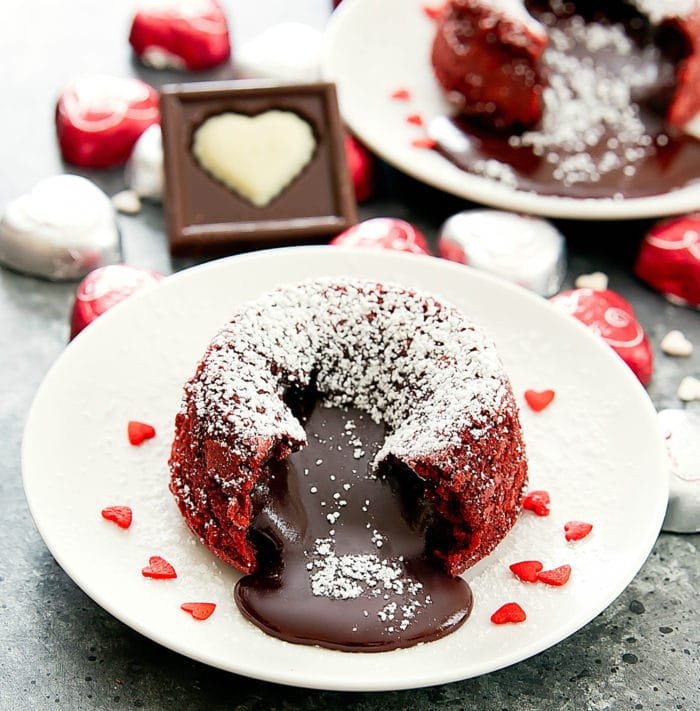
Red velvet molten lava cakes are individual ramekin cakes with a center that stays liquid, and that liquid isn't a sauce you pour in. It's the same cocoa-and-vanilla batter, deliberately underbaked. That's the whole trick. It's also what makes them different from a hot fudge chocolate pudding cake, which builds its own sauce in the pan and gets spooned out, and from a chilled chocolate mousse cake, which sets firm in the fridge. These bake hot and fast, then flip onto a plate while the middle still flows.
Why you'll love this
- One batter, no separate filling: the molten center is simply the part that hasn't set yet.
- Four individual cakes from a 10 to 12 minute bake, so dessert lands hot and on demand.
- Real red velvet flavor from cocoa, vanilla and a little tang, not chocolate cake dyed red.
- Fill the ramekins up to a day ahead and bake them straight from the fridge.
- An optional frozen white chocolate or cream cheese core gives you a molten middle even if your timing slips.
- You can read doneness from the outside, so nobody has to sacrifice a cake to check.
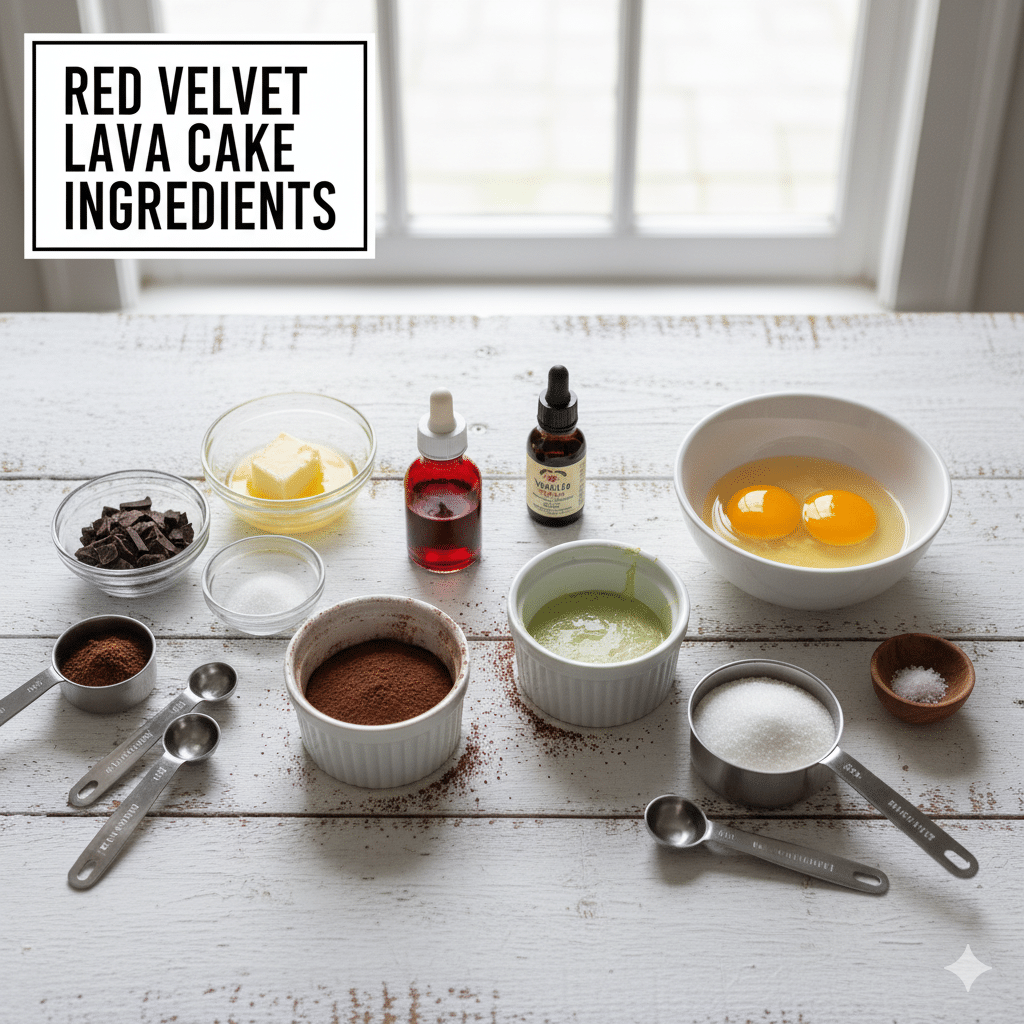
Key ingredients & how to use them
- Unsalted butter — melts with the chocolate for a rich, loose batter, and greases the ramekins. Use softened butter for greasing; melted butter runs down the sides and leaves bare patches where the cake grabs on.
- Semi-sweet chocolate — the heart of the molten center. Chop a bar rather than using chips, which carry stabilizers that stop them flowing. One drop of water in the bowl makes it seize.
- Whole eggs plus extra yolks — structure at the edge, softness in the middle. The extra yolks add fat and emulsifiers, so the unset center stays glossy and thick instead of thin.
- Sugar — sweetens, and whipped with the eggs it traps the air that lifts the edges. Whip until pale and thick enough to fall back in a slow ribbon.
- Flour — just enough to hold the shell together, and the ingredient most likely to kill your lava. A scooped cup packs in extra and sets the center. Spoon and level, or weigh it.
- Cocoa powder — flavor, color, and the ramekin dusting. Natural cocoa is lighter and leans red; Dutch-process is darker and drags the crumb toward brown.
- Red gel food coloring — gel colors hard without thinning the batter. Liquid coloring takes so much volume that it slackens the mix, and it fades in a hot oven.
- Vanilla — the note that makes this red velvet instead of plain chocolate. Use real extract; in a batter this short, you taste it.
- Salt — a pinch sharpens the cocoa. Leave it out and the cakes read flat and one-note sweet.
How to make it (step by step)
-
 1
1Heat the oven and prep the ramekins
Heat the oven to 425°F (220°C), rack in the middle, with a sheet pan already inside. Grease four 6-ounce ramekins with softened butter, brushing upward from base to rim so the batter has a clean climb. Dust with cocoa, roll it around, tap out the excess. Chill them while you mix, because a cold coating stays put.
-
2
Melt the butter and chocolate
Melt the butter and chopped chocolate over barely simmering water, or in the microwave in 20-second bursts, stirring between each. Stop while a few lumps remain and let residual heat finish them. You want it glossy and pourable, not hot. Rest it five minutes: warmer than your fingertip will scramble the eggs.
-
3
Whip the eggs, yolks and sugar
Whisk the eggs, extra yolks, sugar, vanilla and salt for two to three minutes, until pale gold and thick enough to fall back in a slow ribbon. That whipped air is the only lift in this batter; there's no baking powder. A hand whisk works, it just takes longer.
-
4
Combine the chocolate and eggs
Pour the cooled chocolate into the eggs in a steady stream while you whisk. The batter thickens and turns satiny within seconds. Scrape the bowl so no chocolate hides at the bottom, where it bakes into a hard streak. Scrambled specks mean it was too hot: strain the batter and carry on.
-
5
Sift and fold in the dry ingredients
Sift the flour and cocoa straight over the batter so there are no lumps to chase later. Fold ten to twelve strokes, until the dry streaks disappear, then stop. Every extra stir builds gluten and tightens the crumb, and a tight crumb bakes through to the middle faster.
-
6
Fold in the red
Add the gel coloring and fold until the batter is one even shade with no marbling. Go slightly louder than looks right: cocoa keeps darkening in the oven, so baked cakes always read deeper than raw batter. Check the bottom of the bowl for unmixed streaks before you fill anything.
-
7
Add a frozen core (optional insurance)
Nervous about timing? Melt 2 ounces of white chocolate into 2 tablespoons of warm cream, or beat 3 tablespoons of cream cheese with a little powdered sugar. Chill, roll four small balls, freeze solid for an hour. Half-fill each ramekin, set a ball in the center, cover with the rest.
-
8
Fill and bake
Divide the batter between the ramekins, about three-quarters full so they have room to puff. Set them on the preheated sheet pan and bake 10 to 12 minutes. The hot pan gives the bottoms a head start, which is exactly what you want: the edges have to set before the middle does.
-
9
Read doneness without cutting one open
Nudge the pan at 9 minutes. You want a matte, slightly puffed ring around the outside and a wobble in the center no wider than a coin, still shiny. Home ovens vary, so 8 to 14 minutes is all normal; trust the look, not the clock. An instant-read in the middle should sit well under 160°F, roughly where egg batter firms up.
-
10
Rest 60 seconds, then invert
Set a timer for one minute the second they leave the oven. That minute firms the shell enough to carry the cake; longer, and residual heat sets the center you worked to keep liquid. Run a thin knife around the edge, put a plate on top, flip in one motion, lift straight up.
-
11
Serve while it flows
Serve immediately, with something cold on the plate. The center runs freely for about five minutes, then thickens into fudge: still delicious, no longer dramatic. Dust with powdered sugar after plating, not before, or it melts into the hot crust and disappears.
Troubleshooting
- The center baked solid — an extra minute, an oven running hot, or flour packed into the cup. Bake one cake first to calibrate, spoon-and-level the flour, and pull them while the middle still wobbles. A frozen ganache core buys about a minute of margin.
- Collapsed, raw cake that won't hold its shape — the opposite problem, where the shell never set. You need a firm band of cake at least half an inch up the sides before you invert. If the whole surface still looks wet and shiny, give them another 60 to 90 seconds.
- Stuck to the ramekin — a missed patch near the rim, melted butter used for greasing, or too long a wait, since sugar glues itself to the dish as it cools. Brush upward with softened butter, dust with cocoa, flip at one minute. For a stuck cake, sit the ramekin in an inch of hot water for 10 seconds.
- Dull brown instead of red — Dutch-process cocoa and very dark chocolate both push the crumb toward brown, and liquid coloring fades in a hot oven. Use natural cocoa and gel color, and add enough that the raw batter looks a shade brighter than your target.
- Dry, cakey edges — wide, shallow dishes give the heat too much surface, so the batter sets through before you can catch it. Straight-sided 6-ounce ramekins about 3 inches across hold the right depth. An oven thermometer is worth a few dollars if your bakes always run long.
Pro tips
- Bake one cake by itself first to learn your oven, then run the other three at the same setting.
- Weigh the flour if you can: a quarter cup plus 2 tablespoons is about 45 grams, and 5 grams extra is the difference between molten and set.
- Butter and cocoa the ramekins early, then chill them while you mix the batter.
- Don't open the oven before 8 minutes. The temperature drop stalls the edge set and you end up baking longer overall.
- Batter baked from the fridge starts colder in the middle, so add 2 to 3 minutes; that wider window actually makes a molten center easier to hit.
- Have plates and ice cream ready before the timer goes. These cakes don't wait for anybody.
Variations & substitutions
- Cream cheese core: beat 3 tablespoons of cream cheese with 1 tablespoon of powdered sugar, freeze in four small discs, press one into each filled ramekin.
- White chocolate ganache core: melt 2 ounces of white chocolate into 2 tablespoons of warm cream, chill, roll into balls, freeze solid. The closest thing to a guaranteed lava center.
- More red velvet tang: add a quarter teaspoon of white vinegar or a squeeze of lemon with the vanilla. Small change, but it's what separates red velvet from chocolate cake.
- Natural color: swap in 2 teaspoons of beet powder for the food coloring. Expect a muted brick red, and don't overbake, because heat fades it fast.
- No ramekins: butter and cocoa a muffin tin generously, fill six cups two-thirds full, bake 8 to 9 minutes, and rest 2 minutes before turning out. They're more fragile.
- Gluten-free: a 1:1 gluten-free blend works with no other change, since the flour quantity is tiny.
Storage & make-ahead
Filled, unbaked ramekins keep in the fridge for up to 24 hours with plastic wrap pressed to the surface, and bake straight from cold with 2 to 3 extra minutes. You can freeze them wrapped for up to a month: bake from frozen, add 5 to 6 minutes, start checking early. Baked cakes are a next-day snack rather than a lava cake. Refrigerate up to 2 days and warm one for 15 to 20 seconds in the microwave; the center softens, but it won't flow again.
Serving ideas
Cold against hot is the whole point. Vanilla ice cream is the classic, though a spoonful of cream cheese whipped cream (whip 2 tablespoons of cream cheese into half a cup of heavy cream with a little powdered sugar) nods to red velvet frosting and cuts the richness better. Raspberries bring the acidity chocolate wants. Finish with powdered sugar, white chocolate curls, and strong coffee alongside.
More recipes to try
That molten center comes down to pulling them out a minute early, which takes some nerve. If a gooey chocolate middle is what you're after without the timer anxiety, hot fudge chocolate pudding cake makes its own sauce right in the pan. Crack cake is the sweet, crowd-pleasing one I carry to potlucks, and the chocolate raspberry fudge cake keeps that berry-and-cocoa pairing going in layer form.
Recipe
Red Velvet Molten Lava Cakes u002du002d The Ultimate Gooey Treat You'll Love
Ingredients
- ¼ cup unsalted butter
- 2 oz semi-sweet chocolate
- 2 eggs + 2 yolks
- ⅓ cup sugar
- 2 tbsp cocoa powder
- ¼ cup + 2 tbsp flour
- 1 tsp vanilla
- 1–2 tsp red food coloring
- Pinch of salt
Instructions
- Preheat the oven to 425°F (220°C). Grease the ramekins with softened butter and dust them with cocoa powder instead of flour.
- Melt the butter and chocolate together until smooth, then let cool slightly.
- Whip the eggs, yolks and sugar with the vanilla and salt until pale and slightly foamy.
- Whisk the melted chocolate mixture into the egg mixture.
- Sift in the flour and cocoa and fold gently. Add the red food coloring and fold until evenly colored.
- Divide the mixture into the ramekins and bake for 10-12 minutes, until the edges are set and the center still wobbles.
- Rest 1 minute, then invert and serve hot with toppings.
Tips & notes
- Do not overbake, or the middle will not stay molten.
- For the best taste, use high-quality chocolate.
- You can refrigerate the batter up to 24 hours prior to baking; bake straight from the fridge and add 2-3 minutes.
- Use straight-sided 6 oz ramekins about 3 inches across; wider, shallower dishes bake through to the center.
- For a guaranteed molten middle, freeze small balls of white chocolate ganache or sweetened cream cheese and press one into each ramekin before baking.
Watch how to make it
Nutrition · per serving (estimate)
Made this recipe?
Tap the stars to leave your rating — it helps other home cooks.
Frequently asked questions
How do I know when lava cakes are done?
The edges should look matte, set and slightly puffed, while the very center still jiggles when you nudge the ramekin. That wobble should be no wider than a coin and still look shiny. When in doubt, pull them early rather than late, because they keep cooking for a minute after they leave the oven.
Why isn't my center molten?
It baked a little too long, or there was too much flour in the batter. Lava cakes are deliberately underbaked, so an extra minute or an over-packed measuring cup can set the middle solid. Bake one test ramekin to find your oven's sweet spot, then bake the rest at that timing.
Is the molten center a separate sauce?
No. It's the same batter as the rest of the cake, simply underbaked so it never sets. That's what makes these different from a hot fudge chocolate pudding cake, where a cocoa-sugar topping and hot water create a real sauce in the pan that you spoon out.
Can I make the batter ahead of time?
Yes. Fill the ramekins and refrigerate the unbaked batter for up to 24 hours, then bake straight from the fridge and add 2 to 3 minutes. Cold batter gives you a slightly wider window to catch that molten center, which helps when you're feeding guests.
Can I freeze red velvet lava cakes?
Freeze them unbaked. Fill the ramekins, wrap them well and freeze for up to a month, then bake from frozen with 5 to 6 extra minutes, checking early. Freezing already-baked cakes works for storage, but the center firms up and won't flow again after reheating.
Why dust the ramekins with cocoa instead of flour?
Flour leaves a pale, chalky film on the outside of a dark chocolate cake. Buttering and dusting with cocoa releases the cakes just as cleanly while keeping the surface a rich, even color. Brush the butter on in upward strokes so the batter has a clean path up the sides.
Why the extra egg yolks?
The extra yolks add fat and emulsifiers, which help the cake set at the edges while the center stays soft and flowing. They're the reason the molten middle is glossy and thick rather than thin and runny. Skip them and you get a plainer, more uniform little cake.
How do I get the cakes out of the ramekins cleanly?
Let them rest about one minute, run a thin knife around the inside edge, then set a plate over the ramekin and flip in one confident motion. Lift the ramekin straight up. If a cake sticks, sit the ramekin in an inch of hot water for about 10 seconds and try again.
Why did my cakes bake brown instead of red?
Dutch-process cocoa and very dark chocolate both push the crumb toward brown, and liquid food coloring fades in a hot oven. Use natural cocoa and gel coloring, and add enough that the raw batter looks a shade brighter than the color you actually want.
Can I bake these without ramekins?
A standard muffin tin works if you butter and cocoa it generously. Fill six cups two-thirds full and bake 8 to 9 minutes, then rest 2 minutes before turning them out. They're more fragile than ramekin cakes, so loosen the edges gently before flipping.


Leave a review