
3-Ingredient Protein Powder Mug Cake (No Flour, Post-Workout)
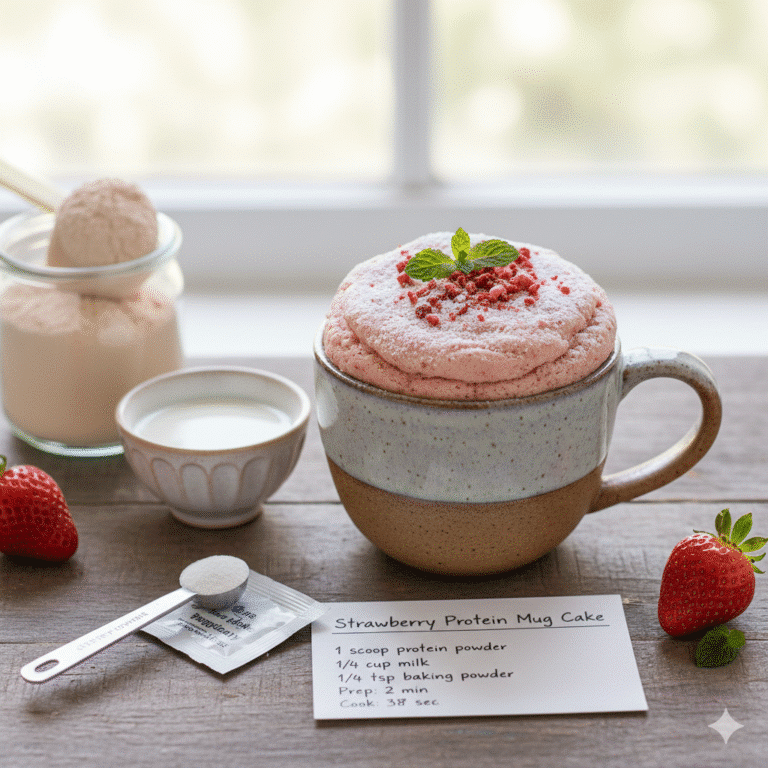
This 3-ingredient protein powder mug cake is the post-workout one: the protein powder does the job flour normally does, so there's no flour, no sugar and no egg in the mug. That makes it behave nothing like the plain 3-ingredient mug cake on this site, which is built on flour, or the Kodiak mug cake, where a pancake mix carries the structure. Protein sets hard and fast under a microwave, so the whole skill here is pulling it out early. Get that right and you get a warm, soft, genuinely cake-like scoop of protein in about two minutes.
Why you'll love this
- Three ingredients, one mug, one fork, about two minutes start to finish.
- The protein powder replaces flour completely, so it lands high in protein and low in sugar.
- This is the protein powder version specifically: the plain 3-ingredient mug cake is built on flour, the Kodiak mug cake uses a pancake mix, and the Shakeology mug cake starts from a meal-replacement blend.
- Separate guidance for whey, casein and plant protein, which behave nothing alike in a microwave.
- A true single serving, so there's no leftover cake sitting on the counter.
Key ingredients & how to use them
- Protein powder — one 30g scoop doing everything flour usually does: structure, bulk, flavor. The powder is the cake, so pick a flavor you'd happily drink on its own.
- Whey concentrate or a blend — the closest thing to real cake crumb, and my default. Whey firms fast and wrings out its own water once it overheats, which is where that squeaky bite comes from.
- Whey isolate — stripped of most fat and lactose, so there's little left to keep it tender and it dries out in seconds. If isolate is all you have, add a tablespoon of milk and cut 8 seconds off.
- Casein — the forgiving one. It soaks up a lot of liquid and doesn't seize under heat the way whey does, staying soft and pudding-like even if you overshoot. Expect a thick batter, so add a splash.
- Plant protein — pea, rice and soy blends carry fiber and starch, so they drink far more liquid and keep thickening in the mug. Start with 1 to 2 extra tablespoons of milk and let it sit.
- Milk — 1/4 cup is a starting point, not a fixed number, since every powder absorbs differently. Dairy gives the richest crumb; almond, soy and oat all work fine.
- Baking powder — with no egg and no creamed butter, that 1/4 teaspoon is your only lift. Whisk it through the dry powder first, because a pocket of it tastes soapy and metallic.
- The sweetener already in your powder — you're adding no sugar, so whatever sweetened the powder is what you'll taste. Sucralose and stevia both turn sharper under heat, which catches people out on the first mug.
How to make it (step by step)
-
1
Pick a roomy mug
Use a straight-sided, microwave-safe mug that holds 10 to 12 ounces, filled no more than halfway. Protein batter puffs up hard in the last few seconds, so a narrow or nearly full mug will go over the rim. Wider is better here, because microwaves only reach about an inch into the batter.
-
2
Match the time to your wattage
The 38 seconds in the card suits a roughly 1,000-watt microwave. At 1,100 watts, start at 30 seconds; on an older 700-watt oven you're nearer 50. The wattage is on a sticker inside the door frame. Treat your first mug cake as the calibration run.
-
3
Whisk the dry ingredients first
Stir the protein powder and baking powder together with a fork in the empty mug, before any liquid goes in. Protein powder clumps the second it meets milk, and those clumps stay chalky right through cooking. Ten seconds of dry stirring saves a minute of lump-chasing.
-
4
Add the milk and stir just to smooth
Pour in the milk and stir until the batter is even, then stop. Twenty strokes is plenty. Beating it hard whips air into the whey that inflates in the microwave and then collapses into a dense, damp layer at the bottom.
-
5
Check the batter's thickness
You want thick pancake batter that slides slowly off the fork, not a paste and not a drink. Too thick cooks up heavy and dry; too thin leaves a raw middle. If you're using plant protein, wait a minute and check again, because it keeps absorbing.
-
6
Microwave in one short burst
Set the mug slightly off-center on the turntable, which is a cold spot in a lot of microwaves, and cook your calculated time in one go. Stay and watch it. It rises like a souffle near the end, and the last five seconds decide soft or squeaky.
-
7
Read the middle, not the edges
Pull it when the top has set and springs back at the edge but the very center still looks barely underdone and glossy. That's done. The hot mug keeps cooking it for another 30 seconds on the counter. If the middle is genuinely liquid, give it 5 more seconds, not 20.
-
8
Rest it, then eat it warm
Give it a minute or two on the counter. It's scalding straight out, it firms as it cools, and the texture at two minutes is exactly what you're after. Eat it within about ten minutes, because protein cake goes tight and dry once it's fully cold.
Troubleshooting
- Rubbery and squeaky against your teeth — overcooked, nearly always. Heat bonds whey proteins to each other and wrings out the water they were holding, and that happens in seconds. Cut 8 to 10 seconds and pull it looking underdone.
- Dry and crumbly rather than rubbery — not enough liquid for the powder you're using. Isolates and plant blends both drink more than whey concentrate. Add a tablespoon of milk, or a teaspoon of Greek yogurt or nut butter for fat that holds moisture.
- Smells and tastes eggy — there's no egg in it; that's overheated whey releasing sulfur compounds. Shorter cooking prevents it, casein powders barely do it at all, and cocoa or a drop of vanilla covers what's left.
- Sunken with a raw middle — the outside set before the center caught up, usually from a deep narrow mug or batter that was too thin. Go wider, hold back a splash of milk, and try 50 percent power for a longer stretch.
- Bitter or artificial aftertaste — that's the sweetener in the powder, not the cake. Heat sharpens sucralose and stevia, and there's no sugar or butter here to soften them. A pinch of salt blunts it; cocoa hides it.
- It climbed out of the mug — too much batter, too small a mug, or full power on a strong microwave. Fill halfway, drop to 70 percent power, and stand the mug on a saucer so cleanup is one plate.
Pro tips
- Cook at 50 to 70 percent power for a little longer instead of full power for less time. It's the single biggest texture upgrade available here, because the heat spreads instead of blasting the edges.
- A teaspoon of peanut butter, Greek yogurt or mashed banana adds fat, which buys you a few seconds of margin before the protein toughens.
- Write your calibrated time on a sticky note inside the cupboard. After one run, this recipe is repeatable forever.
- A pinch of salt helps more than extra sweetener does. It rounds off the artificial edge and makes the whole thing read as dessert.
- Want it fudgy? Stop 5 seconds early. Want it firm enough to eat with your hands? Go 5 seconds long and accept a drier crumb.
Variations & substitutions
- Chocolate brownie: chocolate powder, or a teaspoon of cocoa plus an extra tablespoon of milk, since cocoa is thirsty.
- Peanut butter cup: stir a teaspoon of peanut butter through the batter and push a square of dark chocolate into the center before cooking.
- Dairy-free: pea or rice protein with oat or almond milk, 1 to 2 extra tablespoons of liquid, and a minute of resting.
- Casein pudding cake: swap to casein, add 2 tablespoons more milk and cook 30 seconds for a soft, spoonable middle.
- Berry: fold blueberries or crushed freeze-dried strawberries into a vanilla or strawberry powder batter after mixing, not before.
Storage & make-ahead
Eat this one hot. It's a five-minute window rather than a make-ahead dessert, because protein cake tightens and dries as it cools. If one does end up sitting around, cover it, refrigerate up to a day, then stir a teaspoon of milk into the top and warm it for 10 seconds and no longer. What you can prep ahead is the dry mix: whisk protein powder and baking powder together in a jar in multiples, then scoop one portion per mug.
Serving ideas
I eat it straight from the mug with a spoon, usually inside half an hour of finishing a workout. A spoonful of Greek yogurt melting into the top makes it feel like dessert, and warm peanut butter thinned with a few drops of milk is the version I make most. Banana slices, raspberries or a few dark chocolate chips scattered on the hot surface all work.
More recipes to try
Post-workout baking is a weirdly specific hobby, but here we are. The paleo mug cake is the one I reach for when I'm skipping grains and refined sugar, and it comes together just as fast. For a fruitier finish, try the strawberry shortcake mug cake; for a full-on treat night, the Biscoff mug cake wins every time.
Recipe
3-ingredient protein powder mug cake
Ingredients
- 1 scoop strawberry powder
- 1/4 cup milk
- 1/4 teaspoon baking powder
Instructions
- Begin with a microwave-safe mug. An ordinary coffee mug works great.
- Put 1 scoop of your preferred non-isolate protein powder into the mug. Next, add 1/4 cup of milk. Finally, add 1/4 teaspoon baking powder, which makes the mug cake rise.
- Combine the ingredients. Make sure there are no lumps, as they can alter the texture of your mug cake.
- Set the microwave to high and cook for exactly 38 seconds.
- After 38 seconds, carefully remove the mug from the microwave. If the cake appears too wet or undercooked, microwave it for another 5 to 10 seconds, but avoid overcooking, which might cause the cake to dry up. Let it stand for 1 to 2 minutes before eating, as it is very hot and finishes setting as it cools.
Tips & notes
- Don't overmix, or your cake will become dense.
- Be careful when you microwave. Microwave slowly to prevent drying.
- You can adjust sweetness to your taste.
Watch how to make it
Nutrition · per serving (estimate)
Made this recipe?
Tap the stars to leave your rating — it helps other home cooks.
Frequently asked questions
Why is my protein mug cake rubbery and squeaky?
Overcooking, almost every time. Heat makes whey proteins bond to each other and squeeze out the water they were holding, and that happens in seconds rather than minutes. Cut 8 to 10 seconds off next time and pull the mug while the center still looks barely underdone. It finishes setting in the hot mug.
Which protein powder works best in a mug cake?
A whey concentrate or a whey-casein blend gives the most cake-like crumb. Pure casein is the most forgiving, since it stays soft even when you overshoot the time, though it drinks more milk. Whey isolate is the hardest to get right, because almost no fat or lactose is left in it to keep the crumb tender.
How do I adjust the time for my microwave?
The 38 seconds assumes about 1,000 watts. Start at 30 seconds on an 1,100-watt microwave and around 50 on a 700-watt one, then add in 5-second bursts. Your wattage is printed on a sticker inside the door frame. Treat the first cake as a calibration run and note the number that worked.
Can I use water instead of milk?
Yes, water binds the batter fine, though the crumb comes out plainer and slightly drier because there's no fat or milk sugar in it. Any dairy or plant milk gives a richer result. Avoid canned coconut milk, which is heavy enough to weigh the batter down.
Do I really need the baking powder?
Yes. With no egg and no creamed butter, that 1/4 teaspoon is the only lift in the mug, and without it you get a dense, gummy puck. Whisk it into the dry protein powder before adding milk so it spreads evenly instead of sitting in one soapy pocket.
Why does it taste eggy when there's no egg in it?
That's overheated whey rather than anything you added. Heating drives sulfur compounds out of the protein, and they smell exactly like cooked egg. Shorter cooking usually prevents it, casein-based powders rarely do it, and a teaspoon of cocoa or a drop of vanilla masks whatever is left.
Why is there a bitter, artificial aftertaste?
It comes from the sweetener already in your protein powder. Sucralose and stevia both turn sharper and more bitter when heated, and this cake has no sugar or butter in it to round them off. A pinch of salt blunts the bitterness, and a spoon of cocoa covers it well.
Can I make it ahead or freeze it?
Not really. This one has a five-minute window and tightens as it cools, so it's a cook-and-eat recipe. What you can prep is the dry mix: whisk protein powder and baking powder together in a jar in multiples, then scoop one portion per mug. Freezing leaves the texture spongy and wet after thawing.
Can I double it or make two at once?
Make them one mug at a time. Doubling the batter in a single mug gives you a raw center under a rubbery edge, because microwaves only reach about an inch into the batter. Two mugs cooked side by side need roughly 1.5 to 1.8 times the single-mug time, added in short bursts.
Can I add an egg or bake it in the oven instead?
An egg white makes it fluffier and more sponge-like, but then it isn't a three-ingredient cake and it needs a few extra seconds. You can bake it in a ramekin at 350 degrees F for about 12 minutes, though the microwave version stays moister, since a dry oven pulls water out of protein batter.


Leave a review